This time, “COFFEEMAN NIGHT” with a taste of “Cafe de Colombia”.
Saturday 3 August, as the normal events on Wednesday and Thursday were cancelled due to the rain forecast.
A quiet evening and ideal to relax and chat with friends.
Thanks Christian!
Surviving is hard but oh so much fun (sometimes)
This time, “COFFEEMAN NIGHT” with a taste of “Cafe de Colombia”.
Saturday 3 August, as the normal events on Wednesday and Thursday were cancelled due to the rain forecast.



A quiet evening and ideal to relax and chat with friends.
Thanks Christian!
According to our friend Alfred, an “Old China Hand” based in Suzhou:
Note that there are over ten catenary arch suspension bridges in the world longer between the two towers than Aizhai. The longest is in Japan: The Akashi Kaikyō Bridge, also known as the Pearl Bridge, links the city of Kobe on the mainland of Honshu to Iwaya on Awaji Island, in Japan. Since its completion, in 1998, the bridge has the longest central span of any suspension bridge in the world, at 1,991 m. Somewhat longer than the bridge in Hunan. Chinese bridges with a longer central span are: The Xihoumen Bridge in Zhejiang (1650 m) ; the Runyang Bridge at Zhenjiang (1490 m) and the Yiangyin Bridge (1385 m) , both over the Yangtze are also much longer. The Tsingma Bridge in Hong Kong is 1377 m. Several more are in construction. The shorter bridges we see over the Huangpu River in Shanghai are cable stayed bridges.
And according to Wikipedia again the World’s highest suspension bridge is China: The Sidu River Bridge (Siduhe Bridge, 四渡河特大桥) is a 1,222 m-long (4,009 ft) suspension bridge crossing the valley of the Sidu River near Yesanguan in Badong County in Hubei Province. They quote the height above the Sidu River as around 500 m. Note it is also longer than Aizhai!
Seems the Aussie media put me on the wrong track! It is well possible the original “record” was referring to bridge between tunnels”, being a bit far-fetched as a “record”.
And happy to see some people really read my stuff… Thanks Alfred.
Where else? In China, again.
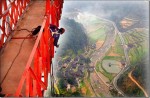
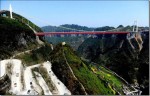

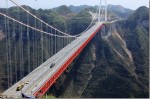
(origin of most pictures is not clear)
Aizhai Bridge in Hunan province is 336 m high and has a 1,176 m span. It connects two traffic tunnels in the mountains, cutting the time needed to traverse the canyon from 30 minutes to 1 minute.
Construction took five years and was finished at the end of 2011.
Vehicles drive motor along a two-way, four-lane motorway. Pedestrians walk along it on a special walkway under the road.
As mentioned earlier (with the wrong number of steps, now corrected), 600 climbed Beijing’s tallest building as part of the Vertical World Circuit. We prefer to call the building “World Trade Center 3”:


Germany’s Thomas Dold came first, sprinting up the 82 flights – and 2,041 steps – to the observation deck of the China World Summit Wing hotel in nine minutes 55 seconds.
The event was co-hosted by the Shangri-La hotels group and the International Skyrunning Federation.
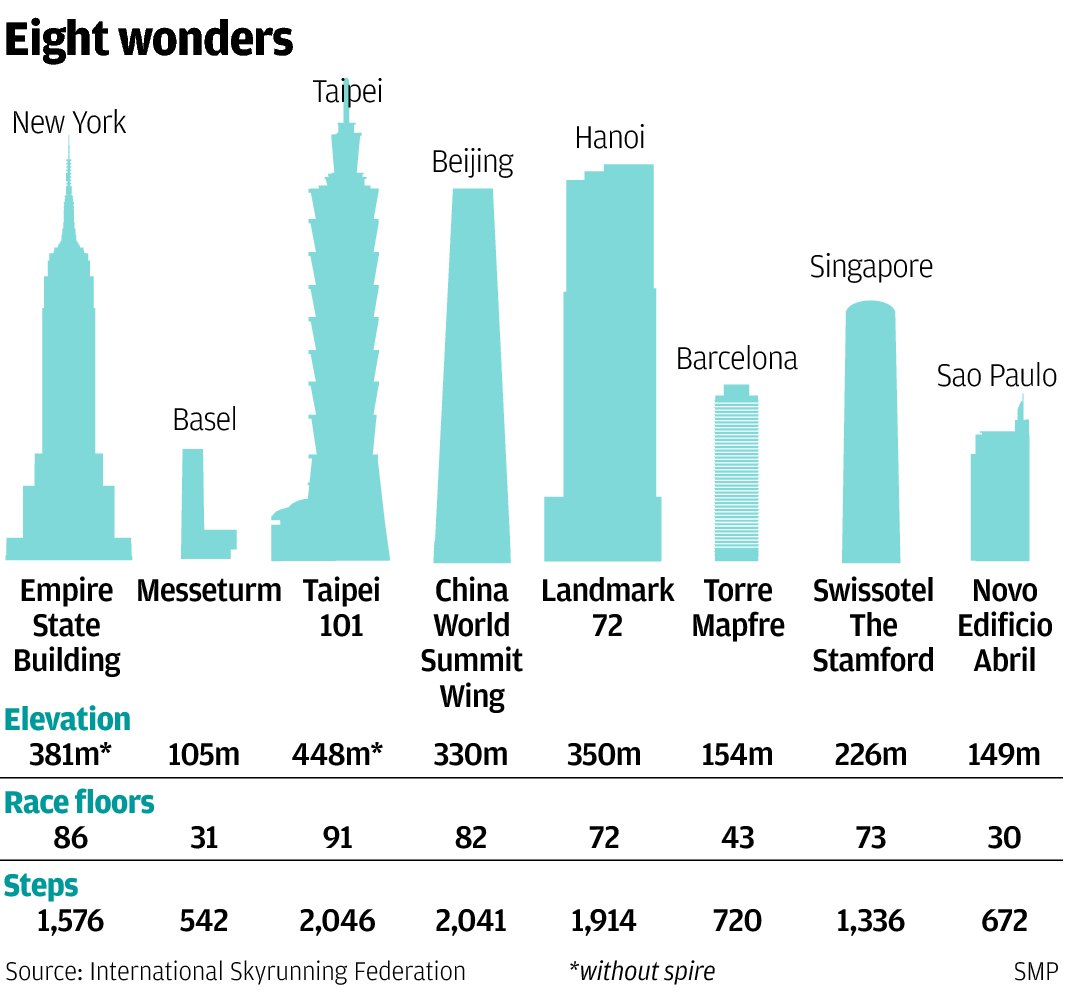
Picture from SCMP.
See the original article:
http://www.scmp.com/news/china/article/1294215/600-climb-beijings-tallest-building-part-vertical-world-circuit
The rankings of the tallest building in China is changing.
At 632 meters and 121 floors, the Shanghai Tower (Pudong district) is now the world’s second-tallest building.
When completed in 2014, the building will have retail and office space, and a luxury hotel. It was designed by the U.S. architectural firm Gensler. It replaces the Shanghai World Financial Center (completed in 2007) as China’s tallest building.
If you want to know what Chinese tend to do wrong (both at home and abroad), this list published by China Daily gives you the picture:
What to do
The following are the rules of etiquette for Chinese citizens traveling abroad as issued by Chinese government:
1. Keep the environment clean. Wrap up your chewing gum before you discard it. Don’t spit on the floor. Don’t litter. Don’t smoke except in designated areas.
2. Observe public order. Don’t yell or shout. While in a line, stay in your line. Don’t talk loudly in public places.
3. Preserve the environment. Stay off public lawns and refrain from picking flowers or fruits. Leave the animals alone and don’t feed them.
4. Protect historical sites and cultural relics. Don’t carve or scrawl on them. Don’t touch or climb on the relics and heed the restrictions when taking photos around them.
5. Be careful with the use of public facilities. Don’t smear or break objects in hotel rooms. Don’t vandalize or damage public facilities. Don’t attempt to make off with public belongings. Conserve water and electricity by using them efficiently. Don’t waste food.
6. Be respectful to the people around you. Don’t try to snap photos with foreigners without their permission. Don’t sneeze into the face of others. Don’t occupy public facilities for too long. Respect the work of service staff. Respect the local religious customs.
7. Be courteous to others. Dress appropriately and don’t go bare-chested or naked while in public areas. Be considerate toward the elderly, people who are ill or disabled. Follow the rule: “Ladies first”. Never use vulgar language.
8. Take part in healthy entertainment. Stay away from pornography, gambling and drugs.
The list came with an article published 1 August 2013: “Chinese tourists told to polish up on etiquette”:
http://www.chinadaily.com.cn/cndy/2013-08/01/content_16859651.htm
More than 1.55 million Chinese students study overseas and the number of Chinese outbound tourists was nearly 83.2 million in 2012.
A poll conducted by US-based e-commerce site Living Social in 2012 found Chinese to be the second-worst tourists in the world, second only to the US respondents themselves.
“It’s embarrassing to see warnings against littering, spitting on the ground or smoking in non-smoking areas only in Chinese characters at some places of interests abroad,” said a tour guide from from a travel agency based in Shanghai.
“In addition to the quality and lack of moral restraint of some Chinese tourists, travel agencies and improper hype by the media also contribute to the obnoxious image of Chinese tourists abroad”.
Never mind what they do in China, right?!